 1 September, 2026
 ASQUARE Medical & IIT-JEE Academy
Career Guidance
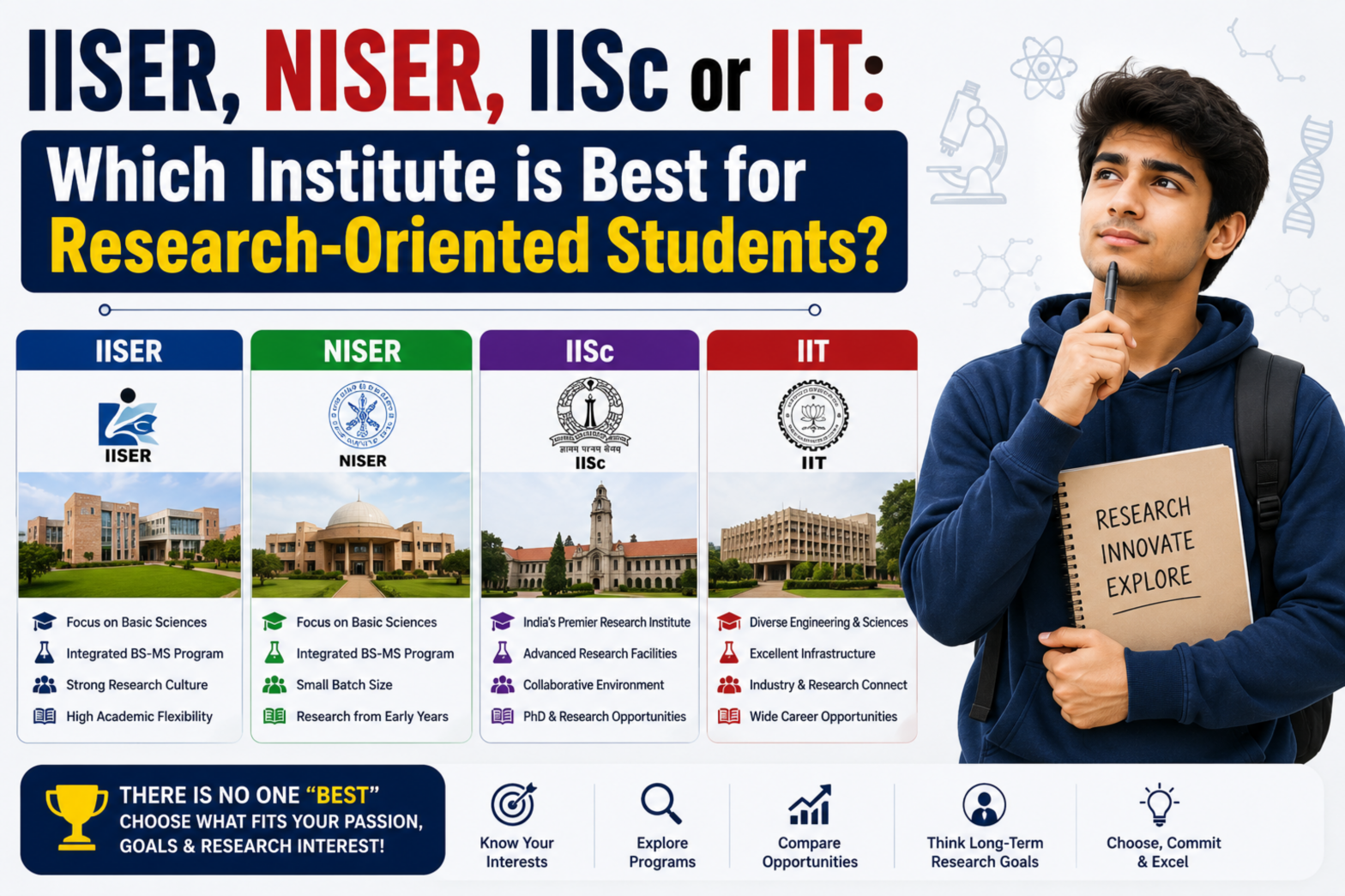
IISER, NISER, IISc or IIT: Which Institute is Best for Research-Oriented Students?
If you are a Class 11 or 12 student who enjoys asking “Why?” instead of simply learning “What?”, you may already be thinking about a career in research.
Maybe you are passionate about figuring out how the universe functions. Maybe you like doing experiments in the laboratory, solving hard mathematical equations, working on organisms, or even creating new technologies.
Now for the big dilemma:
Which do you prefer: IISER, NISER, IISc or IIT?
These are all very prestigious institutes, but there is still an element of difference between the four. If engineering was your thing, then an IIT would definitely top your list, whereas IISER and NISER are both very scientific institutes.
So, which one should a research-oriented student choose?
Let’s make the decision a little easier.
| Institute | Best Suited For | Research Focus | Undergraduate Route |
|---|---|---|---|
| IISER | Basic & interdisciplinary sciences | Very High | BS-MS and other programs |
| NISER | Fundamental sciences | Very High | Integrated MSc |
| IISc | Science, engineering & research | Extremely High | BS (Research) and other programs |
| IIT | Engineering, technology & innovation | High | B.Tech, BS and other programs |
Indian Institutes of Science Education & Research are meant for those students who have a desire to pursue science but at the same time want to get into research.
For those interested in Physics, Chemistry, Biology or Math and who ask themselves “How come this is so?” frequently, IISER could be one choice among many.
The IISER courses promote a learning approach wherein a student gets to learn science subjects as a whole before becoming an expert. One could have chances to engage oneself in research projects, internships and interaction with scientists.
Why consider IISER?
* Strong foundation in basic sciences
* Research exposure during undergraduate study
* Interdisciplinary learning
* Research projects and internships
* Good preparation for higher studies and PhD
* Suitable for careers in scientific research and academia
Who should choose IISER?
IISER is particularly suitable if you want to become a scientist, researcher, professor or work in scientific R&D and have a genuine interest in understanding fundamental scientific concepts.
National Institute of Science Education and Research (NISER), Bhubaneswar is yet another good option for students who have a passion for research in the field of science.
NISER provides integrated MSc course of five years duration to students having cleared Class 12.
Admission into this course takes place on the basis of NEST.
Students get good exposure to the subject of science before going into their specialization in the subject.
NISER can prove to be a very attractive option for students who are sure about future career path.
Why consider NISER?
* Strong focus on fundamental sciences
* Research-oriented academic environment
* Laboratory and practical exposure
* Opportunities to work with researchers
* Good foundation for higher education and PhD
Who should choose NISER?
If you genuinely enjoy pure science and can imagine yourself spending several years studying, experimenting and researching a particular subject, NISER could be an excellent fit.
While talking about research institutions in India, the IISc, Bengaluru, comes up as one of the prominent names.
The IISc has an impressive culture of research in science, engineering, and technology.
What attracts me the most towards the IISc is 4-year BS program offered by the university.
This allows the students to pursue subjects like physics, chemistry, mathematics, biology and earth & environmental sciences, along with solid base in science.
What makes IISc interesting is its combination of fundamental science and advanced technology.
Why consider IISc?
* Strong research environment
* Interdisciplinary education
* Science and engineering exposure
* Undergraduate research opportunities
* Excellent foundation for postgraduate research
* Opportunities to explore advanced scientific fields
Who should choose IISc?
If you love science but are also interested in technology and engineering, IISc can offer a very interesting combination.
Many students think that IITs are only for students who want corporate engineering jobs. That’s not true.
IITs also have extensive research activities in areas such as:
* Artificial Intelligence
* Robotics
* Aerospace
* Biotechnology
* Computer Science
* Materials Science
* Renewable Energy
* Chemical Engineering
* Physics and Mathematics
Suppose you are interested in robotics. You don’t just want to understand the science behind it—you want to design and build robots.
In such a case, an IIT could be a better fit because it combines engineering education with research and innovation.
Why consider IIT?
* Strong engineering foundation
* Research opportunities
* Excellent technology ecosystem
* Industry and R&D exposure
* Strong alumni network
* Opportunities in innovation and entrepreneurship
Who should choose IIT?
IIT may be ideal if you want to combine research with engineering, technology, product development or innovation.
Instead of asking “Which institute is number one?”, ask yourself:
“What do I actually want to study?”
Consider IISER if you are interested in basic and interdisciplinary sciences.
Consider NISER if you are passionate about fundamental science and want to follow a research-heavy academic path.
Consider IISc if you want to combine science, engineering and advanced research.
Consider IIT if you want to work on engineering, technology and applied research.
All four can eventually lead to research careers. Your choice should depend on your interests rather than simply the institute’s reputation.
Your preparation strategy will depend on the institute you are targeting.
For IISER, students currently enter undergraduate programmes through the IISER Aptitude Test (IAT).
For NISER, admission to the Integrated MSc programme is through NEST.
For IISc, undergraduate admissions use specified national examination routes depending on the programme and admission year.
For IITs, students targeting undergraduate engineering programmes generally need to prepare for JEE Main and JEE Advanced, followed by the applicable counselling process.
Since admission rules can change, students should always check the latest official notification before applying.
If you are currently in Class 11 or 12, don’t wait until the last few months to start preparing.
Focus on building strong fundamentals in Physics, Chemistry, Mathematics and Biology, depending on your target examination.
Along with studying theory:
* Solve questions regularly
* Practise previous-year papers
* Take mock tests
* Analyse your mistakes
* Revise important concepts
* Improve speed and accuracy
* Focus on understanding instead of memorising
Most importantly, stay curious. Research is about asking questions, thinking critically and trying to understand things beyond what is written in a textbook.
There is no single winner in the IISER vs NISER vs IISc vs IIT comparison.
If your passion is fundamental science, IISER or NISER may be a natural choice.
If you want science combined with advanced research and technology, IISc can be an excellent option.
If your interests lie in engineering, technology and applied research, IITs can provide a strong pathway.
Ultimately, the best institute is the one that matches your interests, abilities and career goals.
Getting into India’s leading institutes requires consistent preparation and strong conceptual understanding. At ASQUARE Academy, students can build their fundamentals and prepare systematically for competitive examinations such as JEE, NEET and MHT-CET.
Don’t choose an institute only because everyone else is choosing it. First understand what you want to learn, what kind of problems you want to solve and what career you want to build.
Q1. Which is better for research, IISER or IIT?
This depends on your area of interest. While IISERs tend to emphasize on basic and interdisciplinary sciences, IITs conduct research along with engineering, technology, and applied sciences. So, while candidates interested in pure science might opt for IISERs, candidates interested in technological and engineering research may go for IITs.
Q2. Is IISc better than IISER for research?
While both are good institutions for the purpose of conducting research, you need to choose an institute according to your choice of field and subject. IISc provides a good research environment in sciences, engineering and technology, whereas IISERs excel in science education and interdisciplinary research.
Q3. Which is better, IISER or NISER?
Neither is better than the other. This depends on your area of interest. You must compare the two institutes in terms of the courses they offer, their academic environment, research scope and the subject you want to pursue.
Q4. Can I become a scientist after completion of studies from IIT?
Yes. There are chances for doing research in fields such as Physics, Computer Science, Biotechnology, Aerospace, Material Sciences, Artificial Intelligence and Engineering in Indian Institutes of Technology. Candidates can do further studies up to PhD level to make careers in research and development.
Q5. Which entrance examination is necessary for IISER?
According to the admission process, candidates who want to get admission into the IISER undergraduate programs need to give IISER Aptitude Test (IAT). There can be a possibility that admission requirements may change from time to time.
Q6. Which entrance test one needs to write for NISER?
Admission into NISER to the 5-year Integrated MSc program happens through the National Entrance Screening Test (NEST).
Q7. Is it a good option to pursue PhD through IISER?
Yes. The research oriented environment in IISER can be helpful for students for pursuing their PhD in India or abroad. Research work, internships and knowledge of subjects can be beneficial in research field.

Corporate Office
ASQUARE Classes Pvt Ltd, Sai Vrindavan, Nehru Nagar, Pimpri, Pune (MH) - 411018

Phone
Copyright 2026 at asquareclasses.com